Transforming Your Drift Machine using Actionable Insights generated by the Comprehensive Vehicle Optimization App
Within the intensely competitive arena of today's professional sliding, victory is no longer purely a result of brute horsepower or behind-the-wheel bravado. Conversely, it is now a complex discipline which necessitates a scrupulous marriage of choosing a inherently capable car, outfitting it with the highest-quality performance hardware, and, most importantly, comprehending its dynamic performance on the course through cutting-edge suspension tuning applications. This exhaustive manual will serve as your blueprint from the very first concept of a competition vehicle all the way to the last data-informed adjustments that transform a powerful car into a consistent podium finisher. We will thoroughly explore the art and science of chassis dynamics adjustment, showing how a advanced drift tuning app like precise measurement hardware removes approximation and provides unmatched visibility into your vehicle's real-world behavior.
The foundation of any successful competitive sliding vehicle is, undoubtedly, the chassis itself. A select group of vehicles have achieved legendary reputation within the worldwide drifting community due to their built-in handling characteristics, robust build quality, and the enormous availability of performance components available. Choosing the correct car is the initial and most important choice a enthusiast will make. As an example, the BMW's E36 3 Series is universally acknowledged as perhaps the the finest overall drift platforms of history. Its near-perfect 50/50 weight distribution, combined with a RWD setup and extremely reliable six-cylinder powerplants, creates a platform that is both forgiving for newcomers and extremely effective in the possession of a professional pilot. The next step of this concept, the BMW E46, refines these attributes with a more refined chassis, increased wheel track for greater confidence, and still more steering angle as standard from the factory. A different powerful option in the professional scene is the Chevrolet Corvette C6.
This V8-powered track weapon introduces a unique combination of strengths to the sliding sport, including a lightweight aluminium structure, a transaxle-style drivetrain component that helps create an ideal weight distribution, and the immense thrust of a powerful LS-series V8 engine. This fusion makes it an complete weapon on track, designed of initiating and holding long slides with relatively easy application of throttle. For drivers desiring outstanding performance per dollar, the Nissan 350Z stands out as a excellent choice. It is delivered from the manufacturer with a rigid chassis, a competent factory LSD, and the smooth VQ35DE powerplant that provides plenty of power and torque for practicing and advancing in the activity. Its follow-up, the Nissan 370Z, presents additional refinements in chassis stiffness, handling precision, and overall powerplant power, establishing its position as a common selection among professional drivers. Further iconic vehicles that deserve attention include the lightweight Wankel-engined FC generation RX-7, the ever-present Nissan S13, the V8-powered SN95 generation Mustang, the electronic-equipped BMW E90, and the tiny yet surprisingly engaging and instructive Mazda MX-5. All of these chassis offers a different set of characteristics, challenges, and potentials, but they all possess the core elements required to serve as a serious drift machine.
However, selecting the correct chassis is just the starting point. To unlock the complete capability of any of these vehicles, major changes to the steering system and suspension systems are utterly mandatory. This is where the world of specialist aftermarket parts comes into critical importance. The one most transformative upgrade for a serious competition vehicle is the fitting of a high-performance steering angle kit. These engineered kits, like those engineered by performance brands like SLR Speed, are engineered to significantly expand the chassis's maximum steering angle. A factory production vehicle is extremely constrained in how far its steering tires can turn, a engineering compromise for on-road driving. In drifting, but, maximum opposite lock is continuously necessary to control and maintain a slide. An angle kit replaces the stock hubs, linkages, and often suspension arms with components that allow the steered wheels to attain degrees of turn beyond 70 or even 80 degs, compared to a average stock setting of around 40 to 50 degrees.
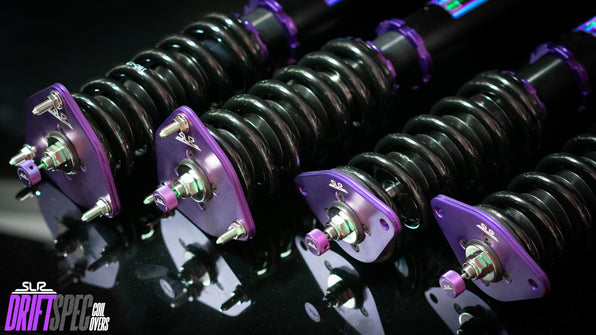
This tremendously expanded lock provides the operator with dramatically greater control during a angle, allowing it to be far more straightforward to begin a slide, sustain it through a sweeping turn, and transition smoothly from one side to the other. The contrast in controllability is absolutely revolutionary. Coupled with a appropriately specified angle kit is the every bit as essential enhancement to the chassis's damping system. Off-the-shelf or including high-end sport adjustable suspension are simply not intended for the unique and extreme requirements of drifting. A purpose-built pair of suspension units is of utmost importance. These specific suspension components incorporate unique valving and spring strength that are optimized for the rapid weight transfer that is inherent of aggressive driving. When a pilot begins a drift, the chassis's mass is shifted rapidly to the outside of the corner. Correct competition coilovers handle this transfer in a consistent manner, enabling the car to stabilize rapidly and offering the pilot clear response through the controls and seat. They additionally enable precise setting of ground clearance, rebound and compression firmness, and corner weighting, which are all key parts of dialing in the chassis's handling to a particular venue or driving style. As a system, a top-tier steering angle kit and a correctly selected pair of competition coilovers form the absolute physical cornerstone upon which all subsequent tuning is based.
Once the core hardware is installed, the next essential stage in the development is the detailed tuning of the chassis's wheel angles. This is the realm of chassis dynamics adjustment, a process that can feel intimidating to the uninitiated but is, in reality, the defining factor to transforming a set of capable components into a unified and predictable whole. The most discussed parameter of suspension geometry for oversteer is certainly camber angle. Camber is the inclination of the rim relative to the perfectly straight axis when observed from the front-on of the car. When the top of the wheel is angled towards the chassis, this is known as inward tilt. In drifting, negative camber on the front axle wheels is generally applied and is considered necessary. The purpose is fundamentally tied to vehicle dynamics.
When a chassis is going around a bend at high slip angles, the chassis rolls toward the outer of the turn. This chassis roll makes the outer front wheel to reduce its best footprint with the tarmac. By introducing inward lean, the wheel is pre-angled to compensate for this tilt. As the vehicle leans into the bend, the outside front tire gains a better contact patch on the road surface, maximizing its grip at the critical time when it is needed most for control. Typically, front axle camber settings for a competition drift machine range from approximately -3 degrees to as extreme as -5 degrees or even more, contingent on the specifics of the vehicle setup, compound choice, and operator preference. The back wheels also use negative camber, but the angles are generally more modest and subtler than the front. Overly aggressive inward lean at the back can cause the vehicle to extremely loose and hard to control on throttle input, as it reduces the usable contact patch of the powered tires during straight-line power delivery. Hence, rear angles are commonly in the range of -1 degree to -3 degrees, finding a precise balance between offering sufficient lateral grip to assist in entering and sustaining the drift while also keeping effective traction for acceleration the bend. Camber is just one part of the broader tuning equation, which furthermore involves toe, caster angle, and steer correction modification.
Toe setting refers to the angle of the wheels as seen from the top. Positive toe means the leading edges of the tires are nearer together than the rear edges, while toe-out means the opposite. For drifting, a slight amount of front toe out is frequently employed to improve the initial response directional feel, making the chassis feel more responsive and ready to initiate a drift. Rear toe setting is usually set to zero or a extremely small amount of inward toe to encourage predictability under power. caster angle is the frontwards or backwards tilt of the steering axis when viewed from the side of the vehicle. More caster angle enhances self-centering and high-velocity confidence, and it additionally increases negative camber gain during steering, which is extremely advantageous. Tuning these parameters is a complex interaction where a adjustment to one value can and often will impact the other settings. The traditional method for setting a vehicle's alignment for drifting has historically been a time-consuming affair of guesswork and adjustment. A driver or engineering group would introduce a adjustment based on experience, run the vehicle on track, rely on the operator's personal sensation and feedback, and then introduce a further adjustment. This process would continue over and over until the chassis felt "good" or the allotted track session ran out. This system is not just incredibly wasteful in terms of hours and resources, but it is furthermore fundamentally flawed.
Driver feel is a infamously unreliable measurement tool, colored by many variables such as exhaustion, varying track grip levels, ambient heat, and simply the mindset of the driver on that specific run. What feels "oversteery" on one pass might feel "pushing" on the following pass, leading to contradictory information and counterproductive adjustments. This traditional challenge in chassis setup is exactly where state-of-the-art technology has intervened to revolutionize the methodology.
The development and integration of sophisticated drift telemetry software has brought about a new era for engineering and optimizing high-performance sliding vehicles. These systems, represented by innovative systems like modern telemetry hardware, function by physically recording the real-time dynamic behavior of the car as it is operated on the track. In contrast to depending on personal feel, these systems acquire measurable data on critical factors such as suspension travel, individual tire rotation, acceleration forces, steering angle, and accelerator and brake pedal position. This acquired data stream is then processed by advanced software that can graph and analyze the metrics in a actionable manner. For the first time, engineers and crews can observe precisely what the vehicle is exhibiting at each millisecond of a drift. This capability changes the entire alignment optimization workflow. Imagine the aforementioned challenge of dialing in the front camber for a given vehicle. Instead of making a change from -3 degrees to -3.5 degrees and then testing multiple laps to try and "feel" a improvement, a suspension tuning tool can deliver immediate and irrefutable information. The software can display in a chart how the suspension's contact patch is behaving during the critical phases of a angle: the initial flick, holding the angle, and switch. It can reveal if the present camber setting is allowing the loaded tire to achieve maximum grip or if the tire is overloaded on its outer shoulder.
The tool can then suggest data-driven advice for adjustment. Perhaps the information reveals that the tire is even overloading its edge at -3.5 degrees of negative camber, implying that a move towards negative camber, say -4 degrees, might be warranted. On the other hand, the data might show that the tread is not achieving temperature or that the inside shoulder is wearing too quickly, which could suggest that there is overly aggressive inward lean and a modest decrease back to -3.2 degrees would be more ideal. This level of granularity and useful insight was completely impossible in the days of pure manual tuning.
The impact of utilizing a comprehensive vehicle dynamics tool goes far beyond only setting alignment. It serves as an essential suspension tuning guide that is tailored to your particular vehicle. When fine-tuning the rebound and compression settings on your adjustable dampers, rather than relying on imprecise advice or copying another team's numbers, you can use the data to observe how the vehicle is performing in response to your tweaks. The application can graph the damper movement trace over a run, showing if the dampers are managing the chassis motion properly or if they are causing the chassis to become unsettled excessively after a direction change. It can help drift tuning app in identifying issues like bottoming out or excessive extension, enabling you to introduce educated decisions to helper springs, rebound/compression values, or stance. This process translates similarly to the detailed art of suspension geometry optimization. In addition to camber angle, the software can give data into how adjustments to toe settings and caster are impacting the car's balance during various phases of a slide. For example, it can assist you to ascertain the ideal amount of front toe-out for your specific steering setup and driving approach by showing the response time of turn-in reaction and the consistency of the car at full steering angle. This makes the software an exceptionally useful performance optimization handbook that is constantly informed by the real-world performance of your personal vehicle on the track. It elevates the complete process from a mysterious craft into a repeatable engineering procedure.
Moreover, the value of a system like data acquisition is not at all restricted to experienced engineers with large budgets. For the club-level competitor, it serves as an incredible educational tool. It practically provides the tuner with the knowledge of a professional race engineer without requiring the corresponding cost. It drastically shortens the development time by providing unambiguous answers to challenges that would traditionally take seasons of experimentation to understand. A tuner can understand how their individual vehicle reacts to specific adjustments, building a more profound understanding of suspension theory in the process. It furthermore democratizes professional chassis dynamics techniques, enabling all drivers with the drive to perfect their car to achieve it in a structured and productive fashion. This is especially significant in a sport like sliding, where engineering know-how has in the past been a closely guarded asset among professional teams. In the modern era, that knowledge can be in the garage of every motivated enthusiast.
In the final analysis, the process to building and dialing in the ideal competitive drift machine is a comprehensive project that smoothly integrates time-honored hardware knowledge with cutting-edge data tools. It commences with drift suspension tuning guide the informed selection of a capable platform, then built upon the installation of critical drift-spec hardware like drift-spec drift angle kits and properly specified competition adjustable dampers. The build then moves into the precision realm of car suspension tuning, where settings like camber angle, toe setting, and caster angle are carefully configured to complement the chassis's upgraded hardware and the operator's personal needs. The final step, and what really separates the today's process from the traditional methods, is the integration of a powerful suspension tuning application. This platform eradicates the approximation and trial and error of only feel-based setup by delivering quantifiable, real-time data on how the vehicle is actually functioning. It functions as an indispensable diagnostic aid, a definitive coilover setup manual, and a comprehensive performance analyzer. Together, this holistic philosophy leads to that each and every aspect of the drift car—from the pick of the car to the last click on the suspension—is perfected for peak performance on the competition venue. It embodies the complete evolution of the art of sliding, bridging mechanical pilot talent with surgical suspension engineering to forge the suspension engineering ultimate effective vehicles imaginable.